
Recycling of rainwater,
and industrial grey waters
France consumes more than 31 billion m3 of water each year. The combined effect of climate change — 2022, 2023 and 2020 are among the three driest years ever recorded — and the growth of industrial, agricultural and domestic uses, this resource is scarce at an unprecedented rate. Hence the importance of recycling rainwater and industrial grey water.
The Water, launched in March 2023 by the French government, sets a clear course: reduce levies by 10% by 2030. Three years later, 77 per cent of the 53 measures in the plan have already been implemented. The movement is on — and companies are directly concerned.
« Water abstraction (pumping in drinking water) by industry decreased by 46% between 1994 and 2023. Good water management has become a fully competitive lever. » — Water plan, balance sheet 3 years, April 2026
Rainwater: a resource still underexploited
Rainwater that falls on industrial roofs, parking lots and waterproofed surfaces is mostly discharged into sewerage systems or natural environments — a considerable loss. Yet, collected and treated, it can feed many non-potable uses: cooling, washing, watering, industrial processes.
The decree of 21 August 2008 regulates the use of rainwater inside and outside buildings. The Grenelle 2 Act and thermal regulations now require storm water management to be taken into account in any new construction or renovation project.
Grey water: the ignored potential of industrial daily life
Grey waters — from washbasins, showers, cleaning processes or cooling water — represent a considerable volume of low-loaded water in industrial and tertiary environments. After proper treatment, they can be reintegrated into a closed circuit, drastically reducing dependence on the public network.
Decree No. 2023-835 and the 11 decrees published in the framework of the Water Plan have removed the main regulatory barriers to the upgrading of unconventional water (ENC): in the agri-food industry, classified facilities (ICPE), and for certain domestic uses. The September 2025 decree extended these possibilities to urban cleanliness.
PFAS
The European Drinking Water Directive (2020) and the PFAS Interministerial Plan of April 2024 require enhanced monitoring of eternal pollutants in discharged and reused waters. Companies using or rejecting per- and polyfluoroalkylated substances (PFAS) are directly affected by these new analytical and traceability obligations.
Water in figures - Water plan 2026
50 years of expertise in water resources
Since its creation, Montanier has been supporting industry, communities and stakeholders in the agri-food sector in controlling their water use. This is not an opportunistic conversion in the face of the climate emergency — It's our DNA.
Our CSR approach fully integrates the issues of the Water Plan: every solution we design aims to reduce pressure on the resource, improve the quality of discharges and secure the water autonomy of our customers, thanks to our CYCLA range and our tailor-made solutions.
- Processing and recycling of industrial process water
- More than 250 recycling/reut Montanier projects
- Rainwater recovery and recovery systems
- Greywater treatment for internal reuse
- Water analysis and characterization (PFAS, micropollutants, PCM)
- Engineering of custom solutions adapted to each sector
- R&D support and regulatory monitoring

Our CSR commitment
Reducing the water footprint of our clients is a direct contribution to France's water plan objectives and climate commitments. Each m3 saved or recycled is a concrete act for future generations.
Montanier has set measurable targets for reducing water consumption in its own processes, and supports its clients towards a sober and resilient management of the resource.
« Investment decisions in water sobriety have become a lever of competitiveness. Companies that anticipate secure their future. » — Montanier, for 50 years at the heart of these challenges
Concrete solutions for each need
Water treatment and recycling should not be an organizational barrier. Our ranges are designed to adapt to the reality of the terrain: ease of installation, modularity and performance.
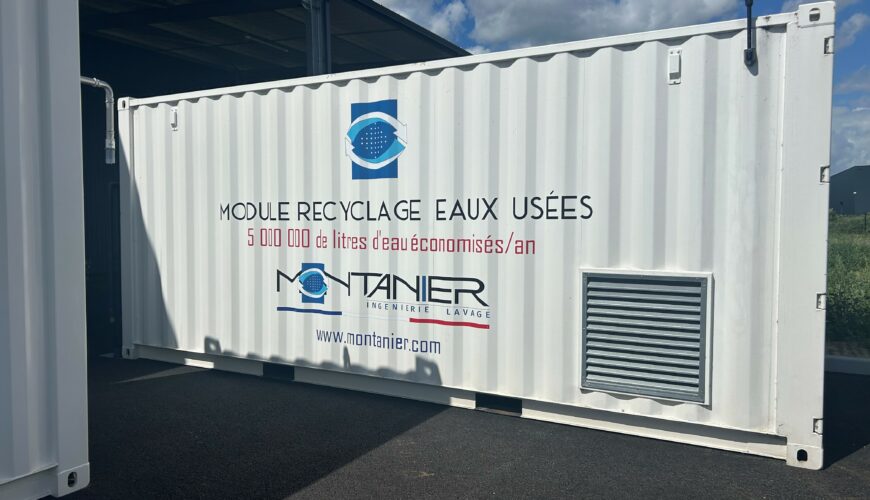
Aboveground solution designed for quick installation without heavy civil engineering. CYCLA X treats collected rainwater and grey water from the industrial process to reintegrate them into a closed or semi-closed circuit.
- Installation above ground — no civil engineering
- Rapid deployment on existing site
- Modular and adaptable to desired flow
- Compatible roof water, storm water, washing water
- Certified treatment according to REUT reuse standards
- Connected real-time performance tracking
In response to increased regulatory requirements for PFAS, pesticides, pharmaceutical residues and micropollutants, LABO offers a comprehensive solution for industrial and agri-food water analysis and characterization.
- PFAS detection according to interdepartmental plan 2024
- PCM analysis (pesticides, contaminants, micropollutants)
- Continuous monitoring or measurement campaigns
- Integrated regulatory reporting interface
- Industrial & agri-food cover
PFAS, micropollutants:
the analysis can no longer wait
Per- and polyfluoroalkylated substances (PFAS) — also called « eternal pollutants » — contaminates water, soil and organisms sustainably. In many industrial processes, these molecules do not degrade and accumulate in the environment.
France, as part of its G7 2026 presidency, is implementing an initiative dedicated to emerging pollutants in water. Monitoring and treatment obligations will intensify in the coming months.
Regulation
-
PFAS Plan 2024 — Action 21 of the Interdepartmental Plan requires strengthening research and monitoring on PFAS substances in industrial and drinking water.
-
Drinking Water Directive 2020 — Total PFS parametric values set at 0.1 μg/L for water intended for human consumption.
-
ICPE and industrial releases — Operators are required to characterize and control their discharges, subject to administrative and financial sanctions.
-
Traceability and reporting — The authorities require accurate documentation of the analysis campaigns and corrective actions undertaken.
Our response: complete lab accompaniment
With the Labo and our R&D hub, Montanier does not just provide equipment. We are building with you a tailor-made monitoring program, adapted to your industry and your specific regulatory obligations.
What we propose
Initial water audit and identification of pollutant risks. Implementation of a PFAS/PCM analysis protocol. Interpretation of results with our R&D team. Recommendation for appropriate treatment solutions. Monitoring and ongoing regulatory reporting.
Did you know that?
Several winners of the Innov'Eau France 2030 programme are working on the destruction of PFAS, including ArianeGroup's ELIXIR process, which destroys more than 99.99% of these substances. Montanier closely follows these innovations to offer you the most advanced solutions.
Accompaniment from end to end
From initial audit to commissioning and regulatory monitoring, Montanier is at your side at every stage. Our approach: understand your water before proposing a solution.
Audit & Diagnostic
Analysis of your current water flows, identification of recovery deposits and pollutant risks.
Custom solution
Recommend a solution adapted to your water, site constraints and CSR objectives.
Installation & commissioning
Deployment by our technical teams, training your operators and performance tests.
Monitoring & R&D
Continuous support, data analysis, system optimization and regulatory oversight.
Ready to regain control
of your water consumption?
Our experts analyze your situation and offer you a solution adapted to your waters, constraints and objectives. First contact without commitment.