
Our projects – transport sector
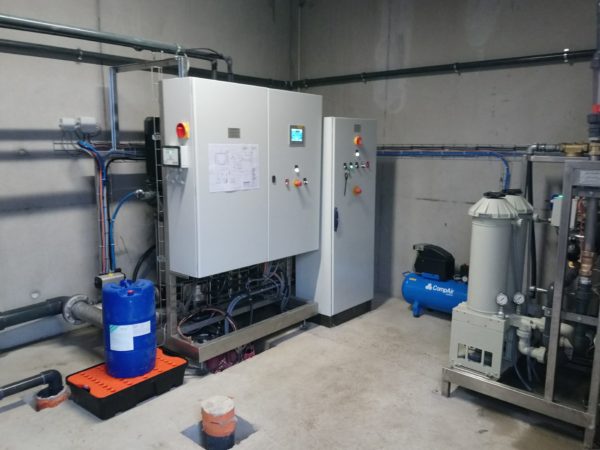
Water treatment
- Prétraitement (enterré) : Mise en place d’une cuve débourbeur en utilisant le principe de décantation. Ce principe consiste à séparer la phase solide de la phase liquide par différence de masse volumique et mise en place d’un séparateur hydrocarbures.
- Traitement secondaire (enterré) : Mise en place d’une cuve de relevage 20m3 avec réacteur biologique aérobie. Le réacteur biologique contient des micro-organismes qui, grâce à l’injection d’oxygène,consomment ainsi la pollution dissoute et se développent. Une pompe de recirculation, installée dans la cuve de relevage, permet de récupérer ces boues. Ensuite, elle les évacue dans la cuve débourbeur.
- Tertiary (aerial) treatment: A filtration skid improves the filtration quality of the recycled water. Once filtered, the water is discharged into a buffer tank for storing the treated water.
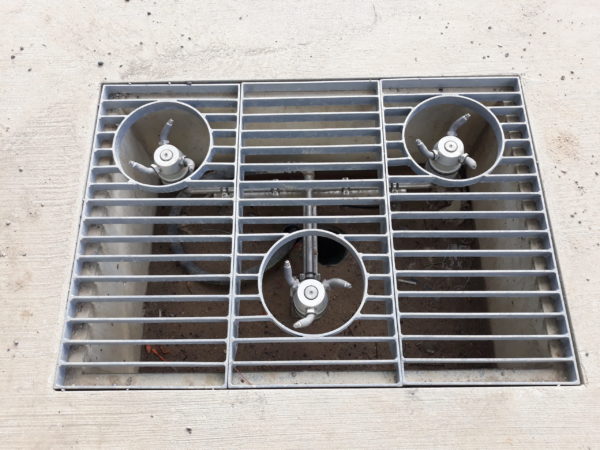
Lave châssis tête rotative
Montanier has innovated with the rotating head chassis washer, composed of three washing heads. These cover an area of approximately 2.20 m x 2.00 m in a triangular shape. This system offers the advantage of versatility, particularly for continuous washing. Its shallow recess in the ground allows for better integration into existing sites and facilitates wastewater drainage (following the water level from the inspection chamber to the gutter). We supply the hot-dip galvanized steel frame to the paving contractor for integration into the masonry. To ensure better guidance, we install a pair of wheel guides, thus limiting the risk of tire pinching. To guarantee excellent washing results, we equip the heads with high-pressure nozzles. This equipment allows for powerful washing, covering a large area. It also prevents any "sketching" effect that could compromise washing quality. These nozzles also ensure that hoses and other fragile undercarriage components will not be damaged. The wash ramp is supplied by a reinforced high-pressure hose. This hose runs underground, through a conduit leading to the technical room. Our team connects it to the high-pressure unit with the necessary valve sets. A custom hot-dip galvanized steel grating is installed on angle brackets between the spray heads.
Read More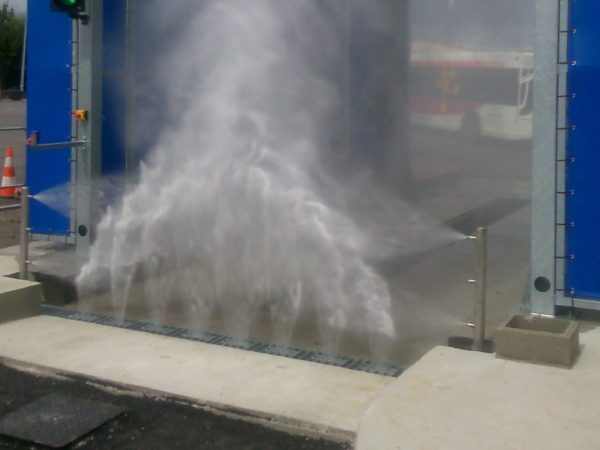
Lave-chassis
Our R&D teams have developed a chassis washer. To improve vehicle wash quality without slowing down the wash cycle, we recommend implementing a continuous chassis, underbody, and wheel washing system. The underbody wash station uses cold water at 300 L/min and 20 bar, and consists of three fixed spray bars equipped with flat jet nozzles. We complement this system with a horizontal spray bar for underbody washing. We have also equipped it with two vertical spray bars for washing the underbody, wheels, and sides of the vehicles. This system allows the lower parts of the vehicle (often soiled with dirt and other particles) to be washed before the brush tunnel or gantry, thus preventing scratches on the bodywork and providing an excellent wash.
Read More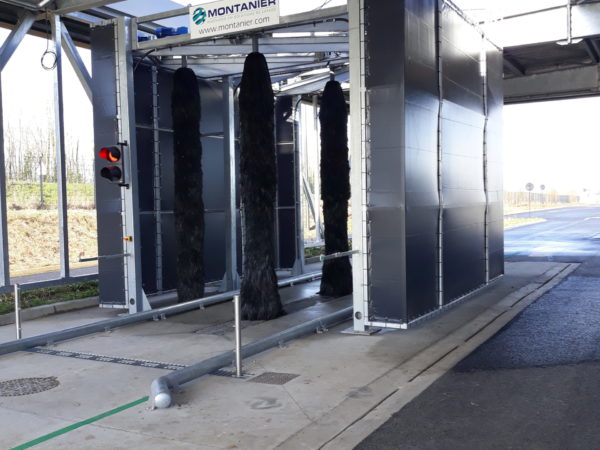
Bus washing tunnel
The bus wash tunnel is a fixed piece of equipment designed for continuous bus washing. Our teams hot-dip galvanize the entire structure. This system allows for both indoor and outdoor installation. We guarantee its longevity and reliability thanks to numerous mechanical components made of stainless steel. This wash tunnel consists of four side brushes and one roof brush. Our R&D team focused on simplifying maintenance. They equipped the tunnel with high-density brushes made of extruded and polished HDPE yarn, and a simplified single-point locking system. We can therefore guarantee that the approximate lifespan of this equipment is 50,000 washes. The rotation of the brushes and the angle of the ramps relative to the direction of travel cause the brushes to open and close upon contact with the vehicle's walls. At the tunnel entrance, we install a roof brush integrated into an additional housing. The rotation of the brush on the bodywork as the bus passes causes it to rise and maintain constant pressure on the entire roof of the vehicle. Three PVC arches, equipped with removable flat jet sprinklers, ensure water distribution. Our teams then complete these arches with 2 vertical and 1 horizontal ramps, fixed to the structure.
Read More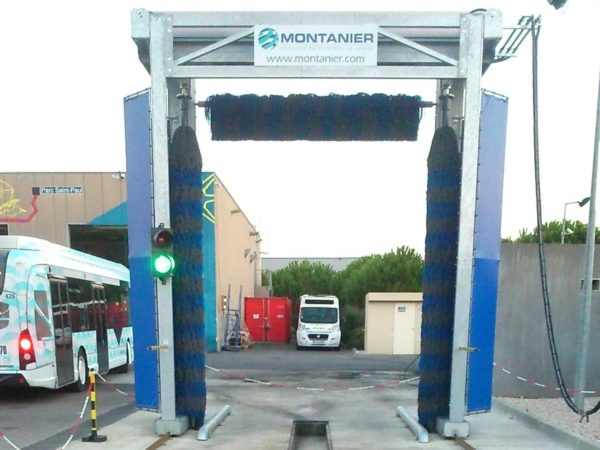
Washing gantry
The Stop & Go wash gantry is a mobile unit designed for washing buses. This gantry is a Montanier innovation. Our teams hot-dip galvanize its entire structure. This system allows for both indoor and outdoor installation. Because it is fully enclosed, we protect the components from the elements. We equip the wash gantry with two side brushes and a roof brush. To power the entire system, we install the two side brushes suspended from motorized carriages. They move along a ramp. They provide front and rear washing with a double sweep, as well as side washing. The horizontal roof brush is mounted on a vertical slide, and its raising and lowering is controlled by a geared motor and a chain drive. We have developed a system of geared motors, controlled by current sensors, which manage the opening and closing of the brushes. Thanks to this ingenious system, the pressure is constantly adjusted according to the force the brushes encounter. The rotation occurs in the direction of vehicle movement (which notably protects roof equipment). Our wash gantry distributes water via two PVC arches. We equip these arches with flat jet nozzles.
Read More +(33) 2 41 67 11 11